Case Converter: Transform Text to UPPERCASE, lowercase, Title Case
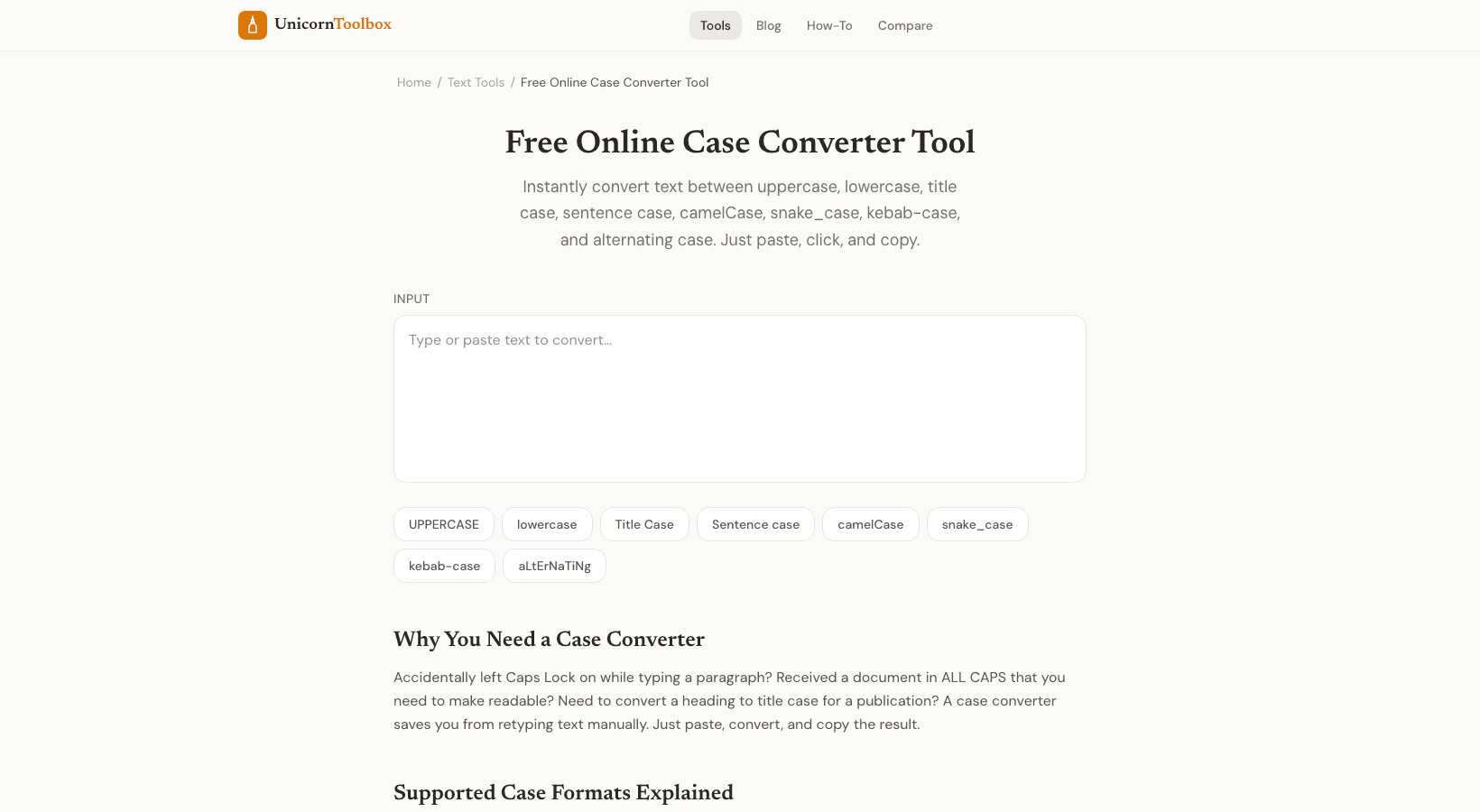
Did you accidentally type a whole paragraph in all caps? Want to change a heading to title case? Do you want to make a label camelCase in your code? The case converter changes all of these texts right away.
Copy and paste your text, choose the format you want, and you're done. Conversions that are available The tool has all the text case formats you might need: ALL CAPS — UPPERCASE. Good for acronyms, headings, and labels. all lowercase letters. Good for making data, email addresses, and URLs the same.
Title Case means that the first letter of each word should be capitalized. Standard for titles and headings. Sentence case means that you should only capitalize the first word. Natural way to read body text. camelCase: noSpacesFirstWordLowercase.
Common naming convention in Java and JavaScript. PascalCase means that there are no spaces and all words are capitalized.d. Used in most programming languages for class names. snake_case means that words are separated by underscores. This is a common way to write Python code and in database columns. kebab-case means "words separated by hyphens." Used in URL slugs and CSS classes.
UPPERCASE_WITH_UNDERSCORES is the same as CONSTANT_CASE. For environment variables and constants. Use Cases for Every Day I use the case converter more often than I thought I would. The most common cases are: Someone sent me a document with headings in all caps, and I need to change them to title case.
Copy, paste, click, and you're done. A lot faster than typing them again. I'm coding and need to change a simple English label like "user first name" into the right format for my codebase. For example, "userFirstName" for JavaScript, "user_first_name" for Python, and "user-first-name" for a CSS class.
One tool takes care of all of them. Another big one is cleaning up data. Do you have a CSV file with names in all caps? Change a lot of them to title case.
Title Case That Works Changing the title case is smarter than just making every word capitalized. It follows the rules of title case in English. Articles (a, an, the), short prepositions (in, on, at), and conjunctions (and, but, or) stay lowercase unless they are the first word. Not The Lord of the Rings, but The Lord of the Rings.
Can deal with special characters It all works, including accented characters, emoji, and Unicode. If you change "uber cool resume" to uppercase, you get "UBER COOL RESUME," which handles accents correctly. Some tools can't handle non-ASCII characters, but this one can.