Free A/B Test Significance Calculator
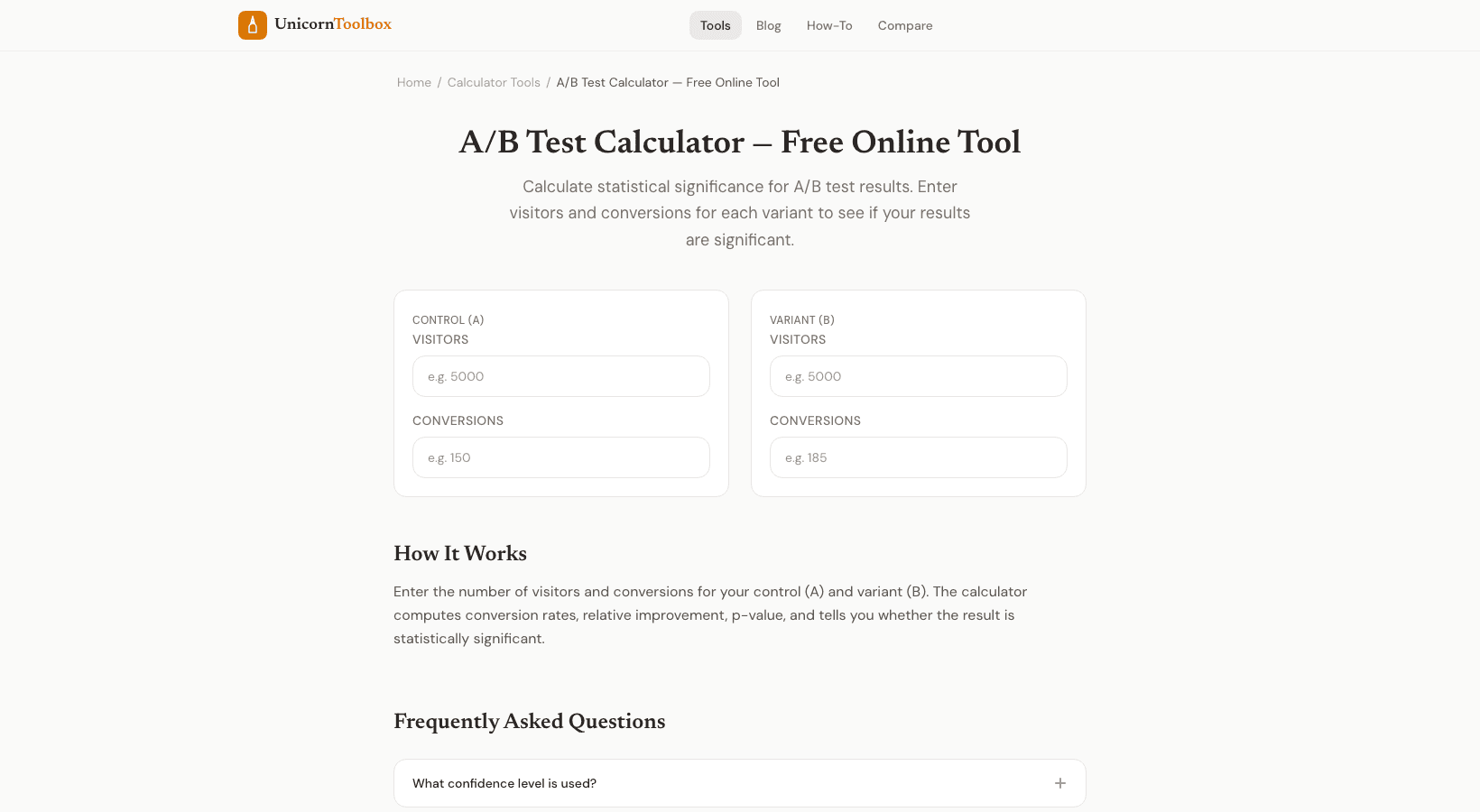
You have been running an A/B test, and variant B has a greater conversion rate than variant A. But is the difference real, or is it just random noise? An A/B test significance calculator will tell you that.
Enter your digits to see if your findings are legitimate. Why Statistical Significance Matters If you do not have statistical significance, you are merely throwing a coin.
If you just look at a tiny sample, one variation might win by coincidence.
I have seen teams rebuild full websites based on A/B test results that were not statistically significant, and then they wonder why the modifications did not succeed. Statistical significance shows you how probable it is that your results are real and not just noise. The conventional level of confidence is 95%, which suggests that there is only a 5% probability that the difference is random.
How to Use the Calculator Put in four numbers for your test: Control visitors is how many people saw version A. Control conversions is how many of them converted.
Variant visitors is how many people saw version B.
Variant conversions is how many of them converted. The calculator shows you the conversion rate for each one, how much better it is than the other, the p-value, and whether the result is above your confidence threshold. You do not need a degree in statistics to use it.
How to Read the Results The most crucial number is the level of confidence. You can be relatively sure the difference is real if it is greater than 95%.
Less than 90%?
You probably need additional data. Between 90 and 95% is a murky area; it matters for certain circumstances but not for others. The calculator also gives the absolute difference and the relative lift (% improvement).
It sounds nice to have a 50% relative lift, but if it is moving from 0.2% to 0.3%, the absolute effect might not be worth the adjustment. Common A/B Testing Mistakes A few things I have learned the hard way: do not look at the results too quickly.
This is called peeking, and it makes false positives seem bigger.
Do not stop the test as soon as it becomes noteworthy. Let it operate for at least a full business cycle. And do not test too many different things at once unless you make adjustments for multiple comparisons.
Also, the amount of samples is more essential than how long the test lasts. Even if you conduct a test for two weeks on pages with minimal traffic, you might not have enough data.
Check Your Test Results Now Stop wondering if your A/B test findings are accurate.
Put in your numbers and get a clear answer. Try it free →