Free Salary Calculator: Calculate Take-Home Pay After Taxes
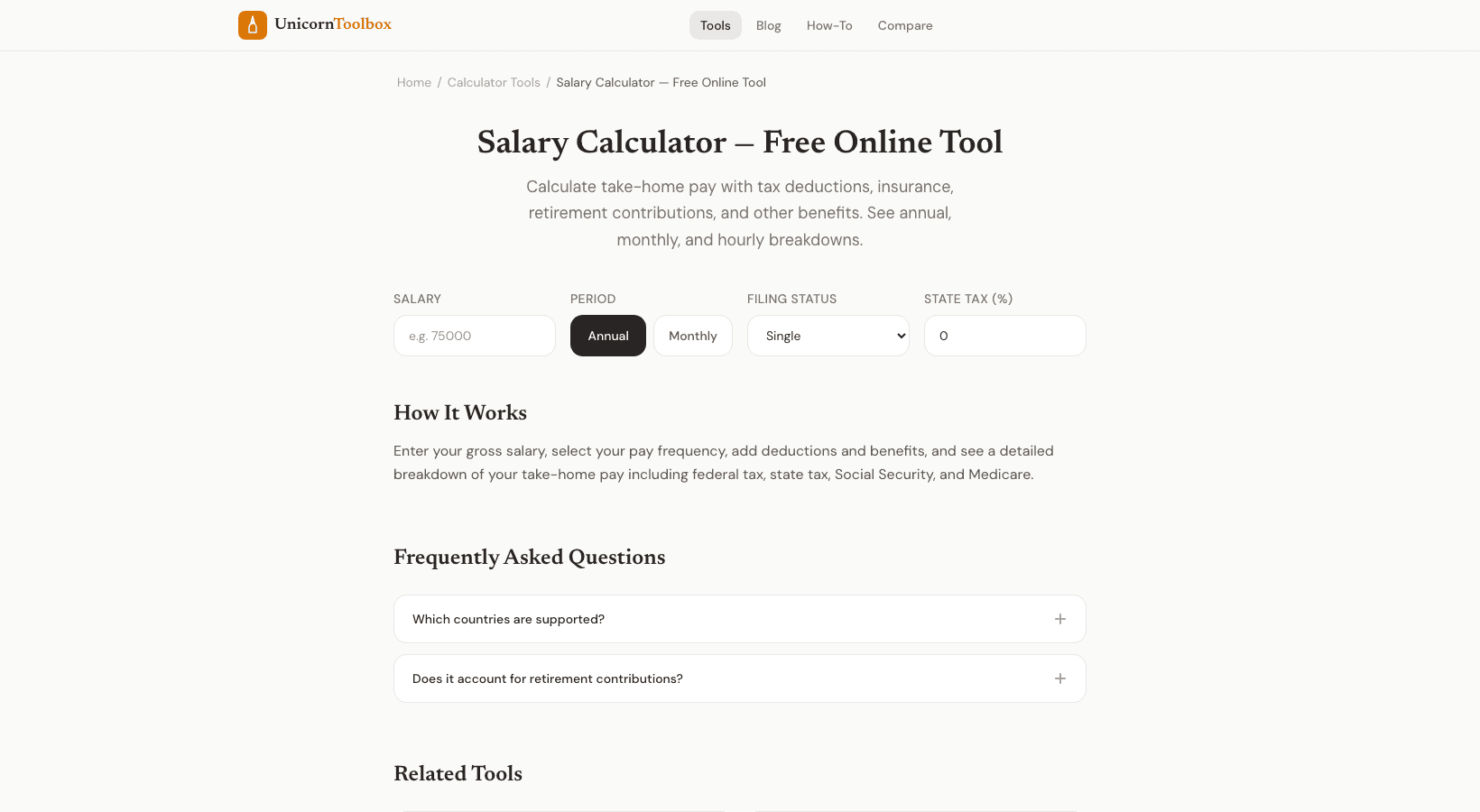
Your salary and your take-home pay are two very different numbers. Between federal taxes, state taxes, Social Security, Medicare, and whatever else gets deducted, the amount that actually hits your bank account can feel like a surprise. A salary calculator breaks it all down so you know exactly what to expect.
What Gets Taken Out of Your Paycheck
If you're a W-2 employee in the US, here's what typically comes out before you see a dime:
- Federal income tax — Based on your tax bracket, filing status, and allowances. This is usually the biggest bite.
- State income tax — Varies wildly by state. Texas and Florida have zero. California and New York... not so much.
- Social Security (FICA) — 6.2% of your salary up to the annual wage base ($168,600 in 2025).
- Medicare — 1.45% of everything, plus an additional 0.9% if you earn over $200K.
- Pre-tax deductions — 401(k) contributions, health insurance premiums, HSA contributions.
How the Calculator Works
Enter your annual salary (or hourly rate and hours), select your state, filing status, and any pre-tax deductions. The salary calculator shows you a complete breakdown: gross pay, each tax and deduction line-item, and your final net take-home pay.
You can view it as annual, monthly, biweekly, or weekly amounts. I find the biweekly view most useful since that's how most people actually get paid.
Comparing Job Offers
This is where the tool really shines. Got two offers — one in Texas at $90K and one in California at $100K? The Texas offer might actually put more money in your pocket because of the state tax difference. Plug both into the calculator and see the real numbers.
Same thing with raises. Your boss offers you a $10K raise and you're excited, but after taxes, that $10K might only be $6,500 in take-home pay. Still great, but good to know the real number.
Freelancer and Contractor Mode
If you're self-employed, the math is different. You pay both the employee AND employer portions of Social Security and Medicare (called self-employment tax), which adds an extra 7.65% on top of regular income taxes. The calculator has a 1099/self-employed mode that accounts for this and shows you quarterly estimated tax payments.
Planning Ahead
I use this every January to plan my budget for the year. Plug in my salary, update my 401(k) contribution, and I know exactly what my biweekly take-home pay will be. No surprises when the first paycheck hits.