Readability Score Checker: Analyze Your Content's Reading Level
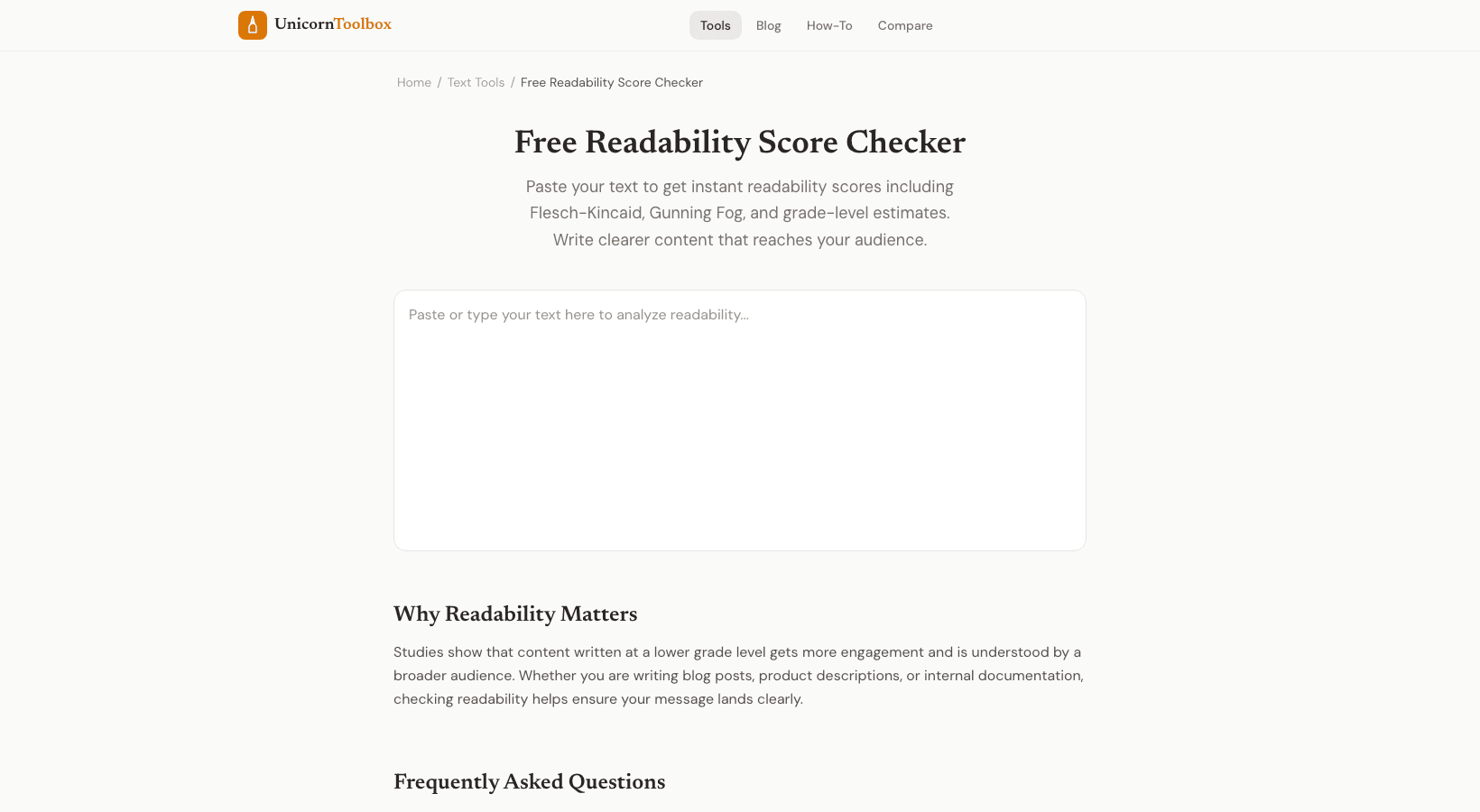
Need a free readability checker to test your readability score? This readability score tool analyzes your writing using Flesch-Kincaid, Gunning Fog, and Coleman-Liau formulas to tell you exactly how hard your content is to read.
If you're writing for the general public, a level between 6th and 8th grade is just right.
Why Readability Scores Are Important It's not about making things easier to understand; it's about being clear.
The best content on the web is written at a level lower than what you might think.
Most big news sites are aimed at kids in grades 6 through 8.
It's even easier to write marketing copy.
If your content is easier to read, more people will finish it, understand what you want them to do, and do it.
Most people leave your blog post before the second paragraph if it sounds like a school paper.
The Scores Explained The checker gives you a number of different readability scores: The Flesch Reading Ease score ranges from 0 to 100.
Higher is easier.
Most web content should be between 60 and 70.
Flesch-Kincaid Grade Level: The U.S.
school grade needed to read the text.
For general audiences, aim for 6-8.
The Gunning Fog Index gives an estimate of how many years of school you need.
It is like grade level, but it gives more weight to difficult words.
The Coleman-Liau Index counts characters instead of syllables, which some researchers like better.
The SMOG Index is made to evaluate health and technical writing.
How to Use the Checker Just paste your text and get scores for all the formulas right away.
The tool marks sentences that are too long, marks hard words, and shows you how many syllables and sentences you have on average.
It tells you exactly what you need to do to fix things.
Before I publish, I run all of my blog posts through this.
It finds sentences where I've crammed three ideas into one or paragraphs that turned into walls of text by accident.
Quick Tips for Making Things Easier to Read The best things to do are to break up long sentences into shorter ones (15–20 words on average), use simple words instead of fancy ones, keep paragraphs to 3–4 sentences, and use subheadings to separate sections.
Using the active voice is also helpful.
"The team shipped the feature" is easier to read than "The feature was shipped by the team." Less mental gymnastics, same information.
Check Your Content Now: Paste your text here and see how easy it is to read.
Get specific tips on how to make your writing easier to read and understand.
Give it a shot for free.